Introduction to Concrete Formwork Connections; A Specialized Guide for Engineers and Project Executors
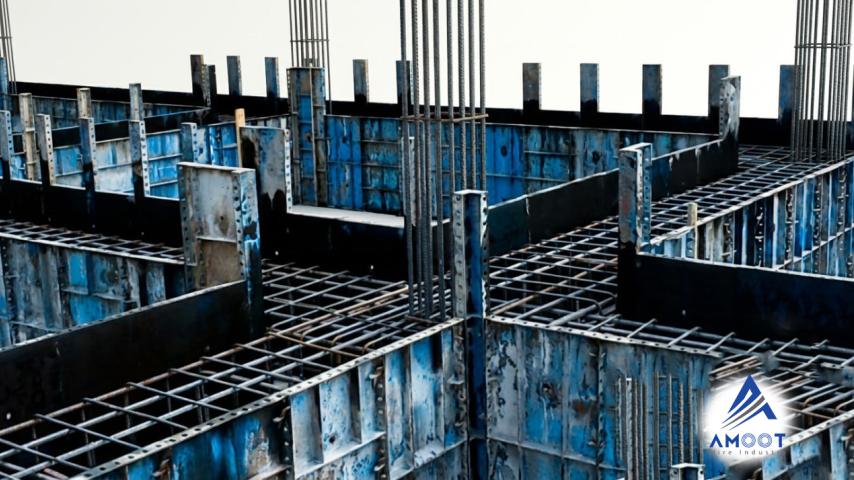
In the execution of various concrete structures, one of the most critical stages is concrete formwork. Creating a reliable and stable formwork system is not possible without using concrete formwork connections. For this reason, every execution engineer, site supervisor, or structural technician must have a thorough understanding of connection types, equipment, materials, and related standards. In this article, we provide a comprehensive introduction to concrete formwork connections and present all the details required for accurate, safe, and principled formwork execution.
Introduction to Concrete Formwork Connections
A proper understanding of concrete formwork connections is one of the most important prerequisites for correct formwork execution in construction projects. Connections ensure the quality of concrete formwork, safety during concreting, and structural durability.
| Connection Type | Main Application | Area of Use | Role in Formwork Stability |
|---|---|---|---|
| Formwork Clamp | Fast panel connection | Steel concrete formwork | Prevents displacement |
| Pin and Wedge | Locking panels | Modular formwork | Stabilizes connection |
| Bolt and Tie Rod | Controlling spacing and concrete pressure | Wall and column formwork | Prevents formwork opening |
| Wing Nut / Plate Nut | Securing bolts | Double-sided formwork | Adjusts lateral concrete pressure |
| Clamp and Panel Connector | Connecting panel edges | Large formworks | Creates structural continuity |
| Bracing Tie and Adjustment Screw | Formwork alignment | Wall formwork | Prevents deviation |
| Horizontal and Vertical Walers | Lateral bracing | Tall formworks | Increases stability |
| Steel Props and Slab Jacks | Load and height support | Slab formwork | Creates stable support |
Types of Concrete Formwork Connections

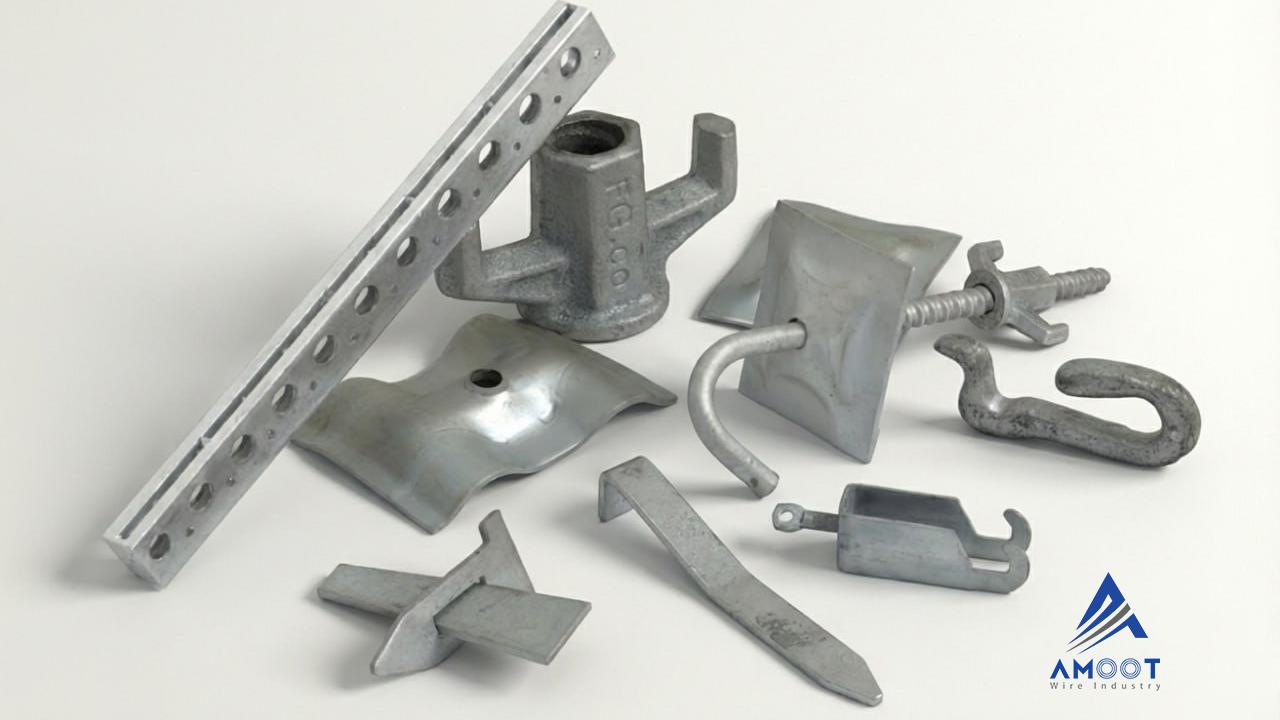
To better understand panel connections and formwork systems, each component must be examined individually. Below, all essential and commonly used connections are introduced along with their applications.
Formwork Clamp
The clamp is one of the key tools for connecting panel edges in steel concrete formwork. It prevents panel displacement during concreting and increases execution speed. Clamps are usually manufactured from steel or ST37 steel plates and provide sufficient resistance against temporary loads.
Pin and Wedge
Pin and wedge are fundamental connections in modular formwork systems. Due to mechanical locking, they provide high assembly speed and good safety during steel formwork installation. The use of reinforced plastic (PP) or steel in these components is very common.
Formwork Bolt and Tie Rod
Bolts combined with tie rods play a critical role in preventing formwork opening. The tie rod maintains a fixed distance between two panels, while the bolt restrains lateral concrete pressure. This connection is one of the most important elements in wall and column formwork.
Wing Nut and Plate Nut
These nuts complete the bolt system and keep the formwork in the desired position by applying appropriate pressure. Their special design allows precise adjustment during execution and correction of installation errors.
Clamp, Panel Connector, and Linking Clamp
These connections are used for fast panel assembly, especially for large panels, and are commonly applied in projects where installation speed is critical.
Corner Clamp
Corner clamps prevent opening at corners in both single-sided and double-sided formwork. This connection is one of the most effective components for preventing vertical alignment errors.
Formwork Bracing Tie and Adjustment Screw
These components are used for precise formwork leveling. When formwork deviates from alignment, the bracing tie or adjustment screw restores it to the correct position.
Horizontal, Vertical, and Pipe Walers
Walers form the primary bracing system of formwork. Vertical walers stabilize the formwork along height, while horizontal walers resist lateral forces. Pipe walers, often referred to as the “final bracing,” are essential in tall formworks.
Cantilever Brace, Formwork Strap, and Scaffold Pipe Clamp
These connections are mainly used to strengthen bracing systems and secure formwork at height. Cantilever braces are commonly applied in heavy formworks and high-rise projects.
Panel-to-Panel Connector
This connection is used to link adjacent panels and has a special application in modular formwork systems.
Auxiliary Equipment Required for Formwork Connections
For installation and securing of connections, the following equipment is essential:
Slab jacks and cross jacks are used to support slab formwork loads and adjust height, ensuring system stability.
Steel props support the weight of fresh concrete in slab or deck formwork until sufficient concrete strength is achieved.
Formwork levelers are essential for preventing execution errors and maintaining verticality, especially in wall and column formwork.
Formwork walers and pipe bracing are used to reinforce panels against concrete pressure and prevent deformation or failure.
Materials Used in Formwork Connections
Formwork connections must be made from materials capable of withstanding temporary loads and construction-site vibrations. Steel, ST37 steel plates, reinforced plastic (PP), FRP composites, and in wooden formworks, Russian timber and formwork plywood are materials that provide the necessary durability and safety.
Types of Formwork and Their Relationship with Concrete Formwork Connections
Understanding different formwork types and how each interacts with formwork connections is a fundamental requirement for safe, standard, and leak-free concrete formwork. Incorrect selection of formwork type or connections can increase lateral concrete pressure, cause formwork opening, misalignment, or even failure of temporary structures.
Wall Formwork
Wall formwork is usually subjected to high lateral pressure from fresh concrete; therefore, connections play the most critical role in preventing formwork opening. In wall formwork, panel connections are achieved using pin and wedge, panel connectors, corner clamps, linking clamps, and tie rods. Tie rods and base plates combined with double-pipe washers control panel spacing and prevent deformation.
Column Formwork
Compared to wall formwork, column formwork has a smaller surface area but experiences higher direct pressure. Therefore, connections must ensure precise alignment and geometry. Formwork clamps, formwork straps, and adjustment screws are three vital connections in column formwork.
Slab Formwork
Due to large surface area and heavy concrete weight, slab formwork relies less on classic wall formwork clamps and more on slab jacks, cross jacks, pipe walers, and formwork levelers. These systems function as connections in slab formwork and transfer vertical loads.
Tunnel Formwork
In tunnel formwork, walls and slabs are formed simultaneously. This modular structure requires highly resistant connections capable of withstanding high concrete pressure and self-weight of the formwork system.
Slip Formwork
Slip formwork is continuously moving; therefore, connections must be lightweight yet sufficiently strong. These connections are typically manufactured from ST37 steel plates and high-strength steel.
Conclusion
In this article, based on execution experience and international standards, we comprehensively explained concrete formwork connections in a precise and practical manner suitable for real projects. From introducing clamps, bolts, walers, and auxiliary equipment to reviewing materials, formwork systems, and safety standards, all key points were presented to help you make the best decisions during steel or wooden formwork assembly.
Frequently Asked Questions
What are concrete formwork connections?
Components such as formwork clamps, pin and wedge, bolts, tie rods, and connectors that join formwork panels and ensure formwork stability against lateral concrete pressure.
Why is the use of bolts and tie rods necessary?
Because they maintain fixed spacing between formworks and prevent formwork opening and concrete leakage, especially in double-sided formwork.
What is the best material for formwork connections?
Steel connections made from ST37 steel plates provide the best balance between strength, durability, and cost.